When Should a Small Interior Design Practice Outsource CGI?
For a small interior design practice, professional CGI can be highly valuable even when it is only needed occasionally. Larger design teams often outsource for capacity, specialist output or presentation quality, while smaller practices tend to use external CGI as a way to access the same level of specialist production without building that capability internally.
We look at the larger-team perspective in our companion article on CGI outsourcing for design and build businesses.
The requirement may only appear several times a year, yet the quality of those few images can carry considerable value.
In that situation, external visualisation gives a small practice access to specialist production whenever the project warrants it.
Specialist quality without building a permanent CGI function
Producing consistently strong imagery involves far more than having access to 3D software - it requires an understanding of lighting, materials, composition, modelling and image production, developed through repeated use.
For designers who need high-quality CGI only occasionally, outsourcing provides direct access to specialist expertise without requiring an ongoing internal setup. It keeps the practice focused on design while making professional visualisation available whenever a project calls for it.
Small practices can access the same visual standard as larger teams
One of the advantages of outsourcing specialist production is that access to quality is not determined by the size of the design practice.
Independent designers can have the same level of specialist visualisation as much larger companies, which can significantly strengthen how their work is presented. This is especially valuable when pitching for larger commissions or helping clients understand a proposal with greater confidence before moving forward.
Keeping the designer's time focused on the project
Small practices often operate with very little separation between design, client communication and project management, where the same person is responsible for developing the concept, preparing documentation and managing the relationship with the client.
Adding detailed CGI production to that workload would consume a disproportionate amount of time, especially when visualisation is not part of the studio's everyday workflow.
An external CGI partner allows the designer to direct the visual outcome while keeping the technical production elsewhere.
Working with the information a small practice already produces
A designer does not need to restructure the entire way they work in order to outsource visualisation.
A CGI studio can usually develop the imagery from the same information used during the design process, provided the brief contains enough detail to communicate the intended scheme.
That may include drawings, existing models, references, sketches, material selections and other project information - the exact combination will vary according to the project.
An experienced CGI artist will easily understand that information and translate the design into a coherent visual result.
Giving clients a clearer understanding of the proposal
CGI is especially useful when the designer and client have very different levels of spatial literacy.
Design professionals are accustomed to understanding plans, elevations, materials and references as parts of a complete space. Private clients often need a more immediate way of seeing how those different elements will work together.
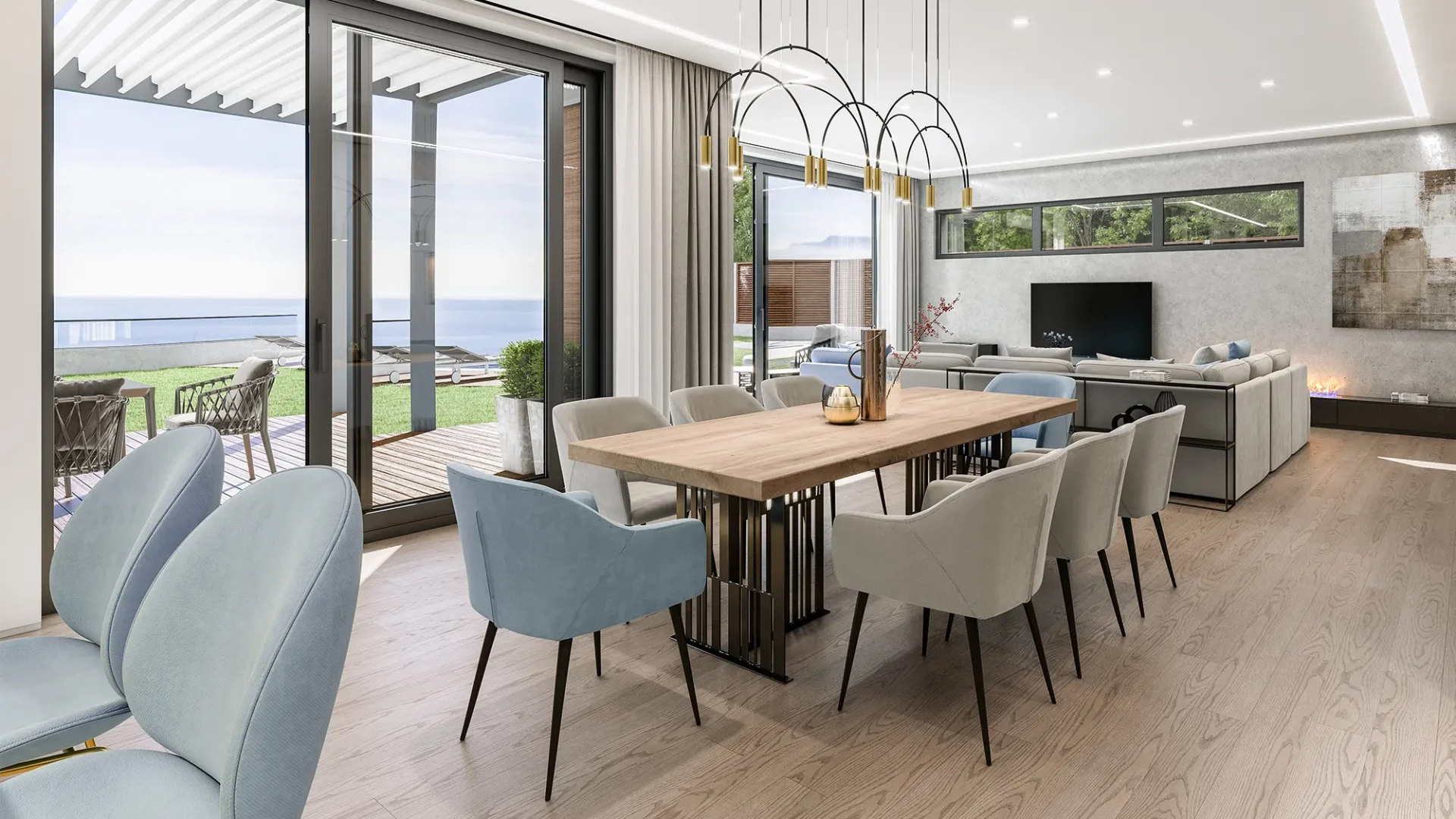
A well-produced visualisation gives both sides a shared reference. It can make discussions around the proposal more precise and allow the client to understand the intended result before physical work begins.
That can be particularly helpful on projects involving a high level of personal decision-making, where confidence in the design plays an important role in approvals.
The value of the image is therefore practical as well as presentational.
A small number of images can have a long working life
For a compact studio, each professionally produced image can carry substantial value beyond the project for which it was originally commissioned.
The imagery may later support the studio's portfolio, website, social media presence, future proposals or editorial submissions.
That gives the visualisation a longer lifespan than the initial client presentation.
For practices commissioning CGI only occasionally, this can make quality especially important. A relatively small collection of strong images can become a significant part of how the business presents its work publicly.
Choosing a partner who fits a small practice
The practical relationship with the CGI studio becomes particularly important when the designer is also the person managing the outsourcing process.
There may be very little spare time available for detailed supervision.
A good partner should therefore be able to understand design information confidently, ask useful questions at the right stage and manage the technical side of production independently once the direction has been established.
Clear communication also matters because the designer needs visibility over progress without being drawn deeply into the mechanics of rendering.
The ideal outcome is a process that gives the practice access to specialist expertise while keeping the additional management burden low.
Staying focused while expanding what the practice can deliver
Small design businesses often benefit from keeping their permanent structure focused.
External specialists allow them to expand their capabilities on a project-by-project basis without changing the nature of the practice itself.
CGI is particularly well suited to this model because the need can vary so widely. Some projects can be communicated effectively without it, while others benefit enormously from a strong visual presentation.
Outsourcing allows the designer to make that decision according to the needs of each project.
The practice remains compact and focused, while its access to specialist production extends much further.
For an independent designer, that can be one of the most practical advantages of working with a professional visualisation studio
Need professional CGI without building the capability in-house?
Visioaxis works with independent designers and small practices that need high-quality visualisation for selected projects, presentations and client approvals.
At Visioaxis, we don’t just showcase spaces -
we help our clients communicate design intent with clarity and precision